Showing posts with label steak club. Show all posts

Saturday, June 04, 2011

Learn About Steaks: Rib Steak!

Among our cow meat, we have ribs, and then we also have rib steaks. What are those? I waited to cook them because I wasn't sure. I had heard of rib eye steaks...but rib steaks? Maybe they just shortened it on my packages because they could only put a certain number of letters?

Nope, they're a real thing.

The 'rib section' of a cow includes ribs numbers six through twelve (so, seven in all), and butchers can make that section into a 'rib roast' all in one piece (or multiple, smaller roasts), or they can cut the individual ribs with steaks, and then they're called 'rib steaks' instead. Some people call these cuts "prime rib" but it's actually kind of a misnomer because they can actually be "prime" or not, and it depends on the USDA grade.

Rib-eye steaks are basically rib steaks where the bone has been removed. They may be from a particular portion; I'm not really sure. It seemed like different websites said different things.

[Note: In the pictures our steaks are kind of small. It's because they are veal. These cuts actually do come quite a bit larger.]

Rib steaks are supposed to have a lot marbling and fat (so, flavor), because of the muscles that they're from, so people don't usually marinade these steaks.

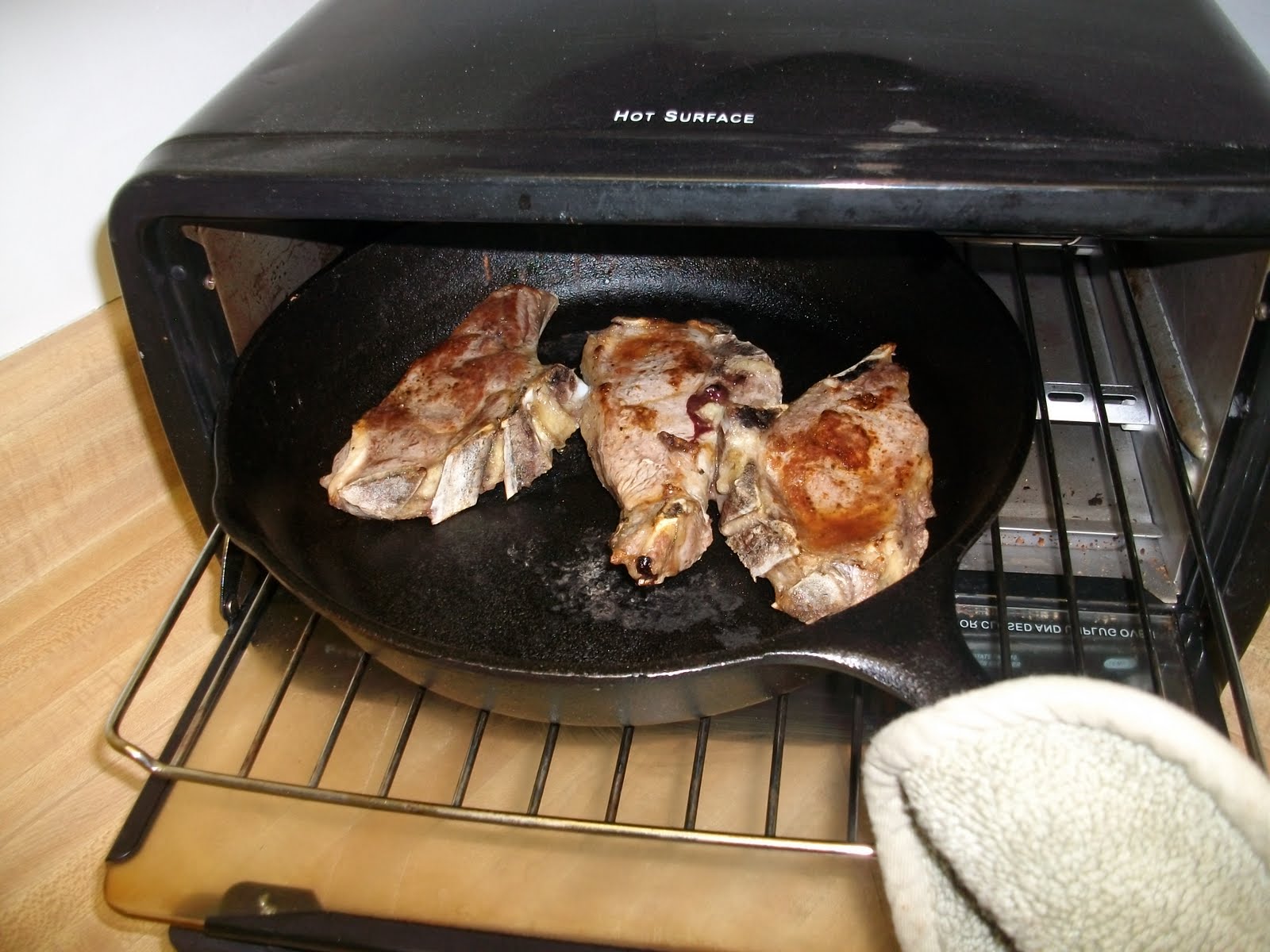
Instead, it seems like the most popular way of preparing rib steaks is the Sear & Blast method. So, this is what I did to prepare ours.

Here's how it works:
1. Preheat your oven to 450 F.
2. On the stove, get a cast iron skillet really hot.
3. Season your steak. I just used salt and pepper.
4. Sear the steak for 3 minutes on the first side, and then flip it over.
5. Move everything into the preheated oven.
6. Cook it in the oven until it is done. (We like our steaks pretty well done, so I think it was 7 or 8 minutes for us. If you want it medium, it's about 6 minutes.)

And that's it. Then you eat it.

Isn't that so easy? Basically preheat everything, start it on the stove, move to the oven, and finish it up.

Your homework:
1. Fill in the blank: A popular method of cooking rib steaks is ________ & _________ .
2. True or false? One must always marinade a rib steak.
3. Cook a rib steak, or a rib eye steak, or prime rib, depending on what is available at your store! (These steaks can also be called market steak.)

(Is anybody actually trying this with me? You should, because steak is delicious, and then later when you're picking a steak you'll know what the actual choices are. They actually don't all taste the same.)

Saturday, December 25, 2010

Learn About Steaks: Top Round! (and "How to Make Beef Jerky!")

Okay, so basically, if you were to slice a cow once, in order to just cut its back legs off (but all in one piece), the piece with the back legs is called the "Round." So, the Top Round is pretty much from the top of that piece. I think kind of on where the hips are. Which is also where the cow's rear-end is. They can make that part of a cow into steaks or roast, or both!

I originally pulled a Top Round steak out of the freezer because J and I were going to make breakfast burritos with steak in them. At the beginning of my research I learned that since they're not fatty, Top Round steaks end up pretty dry if you try to cook them in a pan. Instead, Top Round steaks can be cooked with a slow, moist method, or, people commonly slice Top Round thin and dry it out, to make beef jerky! So I put it in the refrigerator to defrost, and we used a Sirloin steak for the burritos instead.

Making beef jerky is simple! I combined a few recipes to make my own recipe.

After the Top Round steak was defrosted in my fridge, I trimmed all of the visible fat. Fat doesn't dehydrate (it just spoils) so that's why Top Round works well for jerky: it's already lean.

I put the meat in the freezer for about an hour, just to make it firm. Then I sliced* it as thin as I could. When people make beef jerky, they usually try to cut meat against the grain. But, you can also cut it with the grain and it still works.

I wasn't very good at slicing it. I ended up with a lot of little pieces and only a couple big pieces.

Then, I seasoned the slices. When you're making beef jerky, salt is a helper! Salt helps the drying process. I seasoned our steaks with: salt, garlic powder, onion powder, brown sugar, honey, and paprika. I put the steaks all in a quart freezer bag and I added some vinegar. I mushed the meat around to make a marinade. (The picture below is pre-mush to show how much vinegar I added.)

I put the bag of meat back in my fridge to soak up tasty, tasty flavors.

NOTE: People online really like adding soy sauce and worcestershire sauce for their marinades. Most of the recipes I saw online contained both. Apple cider vinegar is also popular. Be brave! Try something fun. Worcestershire sauce contains soy sauce, and soy sauce naturally contains a lot of MSG, so I didn't use them.**

You can marinade your meat for as little as a few hours or up to a day. My day was busy, so I left my meat alone for 23 hours.

Then, I took the meat out of the fridge and put it on trays in my dehydrator. (No overlapping, so the air can move around.) I ground pepper on the strips of meat. I stacked the trays in my dehydrator, set the temperature at 145 degrees F, and plugged it in.

NOTE: Most recipes online recommend spraying your dehydrator trays with nonstick spray first. We don't use nonstick spray at our house, so I didn't do this. If you use nonstick spray, I really recommend using it when you make beef jerky because I had to scrub, scrub, scrub my dehydrator trays.

NOTE: Be liberal in your use of pepper and seasonings! I thought I was putting way too much on, and my jerky came out tasting barely peppered (or seasoned!) at all.

The recipe that I was following that said 145 degrees recommended cooking for 8-10 hours, until the jerky was brown and would bend "like a willow" but not break. My jerky was actually done after about 5 hours. I think it was because I sliced the pieces pretty thin and I didn't have that much drying all at once.

NOTE: You can make beef jerky without a dehydrator! You just use your oven at a low temperature, and prop the door open with a wooden spoon or something, so that the air can circulate. If you're doing this, maybe Google it, though, because there may be other special instructions for oven jerky. (Every site I looked at mentioned ovens too, though, so it's a respectable alternative.)

When my jerky was done, I let it cool a bit and then I put it in a freezer bag to keep it from becoming stale.

Results: We've been eating jerky over the past few days and it is fantastic! "Em, this jerky's really good. The more I eat it, the more I like it," J told me. I had no idea how simple it was to make beef jerky! We will definitely be making a lot more in the future.

Your homework:
1. Point to your "Top Rounds." (HA ha!)
2. Cook a Top Round steak! (Remember, slow and moist, or JERKY!) If you make beef jerky, give yourself an automatic "A" for this assignment.

* See my knife in the pictures? It is a Cutco "Trimmer" knife, and it cost like $60. I bought it because one of my classmates "just needed to practice" his sales pitch, and "it was okay if you don't buy anything--even just watching helps." Lies! If you say no, they try to sell something cheaper, and the sales pitch just goes on forever. BUT, seriously, if I could afford to, I would buy the entire giant, super spendy set. Because I love, love, love this knife! My one Cutco knife is definitely my favorite item in the kitchen. It cuts perfectly. It's like, the Dyson vacuum of kitchen knives: you think you're fine until you try one and then you realize it has always been missing from your life.

** Actually, all of the big commercial brands of beef jerky contain MSG. Most of them don't even hide it at all. They list monosodium glutamate in the ingredients. I just can't in good conscience eat that stuff anymore. Sometimes we'll see places advertising "home made beef jerky!" and I'll feel hopeful, but I've never seen a brand that J could actually eat. It has been a fun treat to have beef jerky around. J really likes it.

Sunday, December 12, 2010

Learn About Steaks: T-Bone!

Is anyone interested in learning about different types of steak with us?

I was thinking it might be fun to share some of our adventures as J and I learn about different types of steak. The thing is, J and I tend to buy ground beef, or cubed steak (plus one time I bought chili ground beef, and once or twice I've bought roasts). So we're not fancy at all when it comes to nice steak. Not yet.

So far we've tried ground beef (which we added to our pasta sauce), a chuck roast, and just now I cooked some T-Bone steaks.

Each time we try something new, I learn how to cook it properly. As we eat, we discuss what part of the cow the meat comes from.* (Most delicious anatomy class ever!)

Today we learned about T-Bone steaks. J guessed that they came from a vertebrae...and he was right! The curve in the bone at the middle of the top of the T is the round part of the vertebrae.

T-Bone steaks are especially fancy because the meat on the different sides of the T are both desirable ones. The larger side of meat comes from the "short loin" and the smaller side comes from the "tenderloin**." Both the short loin and the tenderloin are on the sides of cows, just after the ribs.

When you cook T-Bone steaks, you're supposed to cook them dry, so your main options are to grilling and broiling. You don't have to worry about tenderizing these; they're already tender.

I decided to follow a recipe on the Food Network website. It was way easier than I thought it would be. You heat a little bit of oil in a pan. Salt and pepper your steaks. Put the steaks in your pan, and brown each side (it takes about 4 minutes for each side). Then, move them into a preheated 450 degree oven.*** Cook them until a thermometer reads 120 degrees. (They say 6-8 minutes for a medium-rare steak. I cooked mine for about 10-12 minutes for pretty well-done steaks.) Then take them out and let them cool 10 minutes and cut them off of the bone. (I omitted this step, and J and I each cut our own steaks off of the bones, because it wouldn't have felt like T-Bone steaks if I had pre-cut them. And it would have made them look much smaller.)

Results: I ate mine with steak sauce (after trying it without)**** and asparagus. J ate his plain (and without asparagus). We both thought it was very tasty.

Your homework:
1. Point to where your T-Bone steaks would be, if people had short loins and tenderloins. (Optional: point to a T-Bone on a real cow, or on any other willing and available model.)
2. Try cooking a T-Bone steak!


* Sometimes I use Chalcy to demonstrate. Is that awful, or what? She's big enough. Don't worry. We won't eat our dog.
** Filet mignon comes from the tenderloin, actually. Mmmm.
*** Yes, I used my toaster oven again. :)
**** Not because it tasted bad without it; I just love my A1.